
Search for the best sex positions and you get lists. Ten names, a few illustrations, and a difficulty label that says “advanced” without explaining what is advanced about it. None of that answers the question you actually have: will this work with your back, your hips, or the fact that you have not exercised since 2023?
Two couples can work through the same list and get opposite results from the same position, because difficulty is not a property of the position. It is a match between what a position demands and what a body currently does well. Change either side of that match and the verdict changes.
This guide replaces the list with the four physical variables that decide the match, then applies them across fitness levels, low back pain, body size and height difference, pregnancy and recovery. Standing positions get a section of their own, because that is where fitness stops being theoretical. This article is part of our wider sexual wellness guide for Middle East couples, which covers the health context behind all of it.
Key Takeaways
- Four variables decide whether a position works: spinal flexion load, hip and knee range, balance and upper-body demand, and who controls the pace. The last one has nothing to do with fitness and everything to do with comfort.
- Sex is a real moderate-intensity activity and a small calorie event. In the most-cited laboratory measurement of sex as exercise, 21 young healthy couples averaged 5.8 METs (a MET is roughly the energy cost of sitting still) and about 85 kcal over roughly 25 minutes. That sits above walking and below jogging.
- Back-pain advice usually ignores whose back is hurting. In motion-capture testing, side-lying rear-entry was among the highest spinal-flexion loads for the thrusting partner, yet among the most spine-sparing for the receiving partner. The study covered just 10 couples and is a master’s thesis, so treat the ordering as a strong hint rather than a settled result.
- “I can’t do that position” is usually a support or lubrication problem, not a fitness problem. A wedge pillow and a better-matched lubricant are the fastest changes available, though nobody has measured them against each other.
Does sex actually count as exercise?
Yes, though the measured numbers are smaller than the popular claims. In the most-cited laboratory measurement of sex as exercise, 21 healthy couples averaged 5.8 METs, burned about 85 kcal each (101 for men, 69 for women), and lasted a mean of 24.7 minutes (Frappier et al., PLOS ONE, 2013).
A MET is roughly the energy cost of sitting still, so 5.8 of them is moderate work. The intensity is real. The calorie total is small. Both figures carry a caveat worth stating plainly: the participants were young, healthy, and averaged 22.6 years old.
That figure matters twice over. Sex is a genuine cardiovascular stimulus, which is why people with heart conditions get guidance about it rather than a blanket warning to avoid it. And the widely repeated claim that a session burns 200 to 300 calories does not survive contact with measurement: the same couples burned 276 kcal (men) and 213 kcal (women) during a 30-minute treadmill session, against about 85 kcal during sex.
The link to positions is direct. If sex sits at moderate intensity, a position that asks you to hold your own bodyweight, stay balanced and thrust for fifteen minutes is asking for something closer to a gym set than a cuddle. That is a load rather than a moral failing, and loads can be measured, redistributed, or moved onto furniture.
The cardiovascular question carries a safety note of its own. A large meta-analysis of 14 case-crossover studies found that sexual activity raised the relative risk of triggering an acute cardiac event by a factor of 2.70, and physical exertion by 3.45, while the absolute risk stayed very small.
The same analysis found that people with a higher habitual activity level had roughly 45% lower heart attack risk than those with a lower one, which is a comparison between people rather than a per-session effect (Dahabreh & Paulus, JAMA, 2011).
The occasional spike is real. The regular baseline matters more.
The four variables that decide whether a position works for you
Any position can be described by four things you can assess about yourself in about a minute, without knowing anything about the position’s reputation. Spinal flexion load: how long does the lower back spend curved forward, and under load? Hip and knee range: how much hip flexion or abduction (folding forward, or opening the legs) does it require? Balance and upper-body demand: is your weight on a bed, or on your arms and one leg? And pace control: who decides depth and speed?
The first three decide whether you can do it. The fourth decides whether you will enjoy it, and it is the one most guides leave out.
Pace control gets its own column because it asks nothing of your body. In our beginner’s guide to anal sex positions, the same principle does most of the work, and it applies just as well to every other kind of sex: the position where the receiving partner sets depth and speed is the position where discomfort is least likely. That is a property of the position, not a personality trait of the people in it.
Three conventions make the table readable. Every load rating assumes an adult who can hold the position for three minutes, the same test used for the fitness tiers below, and runs Low, Moderate or High. Where a load falls harder on one partner, that partner is named, because the same position can be easy for one person and hard work for the other. Pace control is listed separately because it is decided by arrangement rather than by fitness.
One caveat on provenance: the grades are our read of the motion-capture findings plus general joint mechanics, not measured values printed in that study.
| Position | Spinal flexion load | Hip and knee range | Balance and upper body | Pace control | Tier |
|---|---|---|---|---|---|
| Missionary, hips flat | Moderate (thrusting) / High (receiving) | Low | Low | Thrusting partner | 2 |
| Missionary, hips and knees flexed | High (both) | High | Low | Thrusting partner | 2 |
| Side-lying, rear-entry | High (thrusting) / Low (receiving) | Low | Low | Either | 1 |
| Rear-entry, receiver on hands | Low (both) | Moderate | High (receiving) | Thrusting partner | 2 |
| Rear-entry, receiver on elbows | Low (both) | Low | Low | Thrusting partner | 2 |
| Receiver on top, upright | Low (receiving) | High | High (receiving) | Receiving partner | 2 |
| Receiver on top, leaning back | Moderate (receiving) | High | High (receiving) | Receiving partner | 2 |
| Standing, facing | Moderate | Moderate | High (both) | Either | 3 |
| Standing, from behind | High (thrusting) | Moderate | High (both) | Thrusting partner | 3 |
| Edge-of-bed or supported | Low to moderate | Low | Low | Either | 1 |
Read the table as a menu of trade-offs rather than a ranking. Nothing on it is free: every position buys something and pays for it somewhere else. If your back is the constraint, you want low spinal flexion. If your hips are the constraint, you want low range. If your fitness is the constraint, you want low balance demand. You rarely get all three at once, which is exactly why a single “best position” list cannot answer the question.
Standing sex positions: what they demand, and who they suit
Standing positions are the highest-demand category, and they are the ones most likely to hurt someone. They stack three requirements at once: sustained lower-limb endurance, balance, and management of the height difference between two people. Neither partner gets to lie down, so nothing is offloaded.
If you are going to try them, offload deliberately. A wall or a sturdy piece of furniture takes balance out of the equation, which removes the variable most likely to end the attempt badly. A bed edge or a counter lets the taller partner stand and the shorter partner sit or lean, which removes the height problem entirely. There is nothing to compensate for. Keep the floor clear and, in a bathroom, take up the mat.
Standing positions are also where the regional baseline shows up. The Ministry of Health and Prevention’s National Health and Nutrition Survey for 2024–2025, which covered 20,000 households and was endorsed by the WHO, found that 59% of UAE adults get insufficient physical activity (ARN News Centre report on the MoHAP survey, 2025).
Insufficient activity is not the same measure as poor conditioning for standing work, but the two overlap heavily. The practical read is the same either way: default to a supported version, and treat the unsupported version as something to work up to.
Which positions suit your fitness level?
Sort positions by the endurance they demand and three tiers fall out. Tier one asks only that you lie down and stay comfortable. Tier two asks for a few minutes of hip range and lower-limb endurance. Tier three asks a lot: whole-body isometric work, holding a position under load without moving, plus good balance. One test separates them. Can you hold it for three minutes without shaking or collapsing? If not, drop a tier. Pushing through costs more than it returns.
Tier one is side-lying and edge-of-bed or supported variants. Bed and furniture carry the weight, so the balance and hip-range demands stay Low, though in side-lying the thrusting partner still carries a High spinal-flexion load. Tier two is where most couples live: missionary with real support under the hips, rear-entry with the receiver on elbows, and receiver-on-top in either posture. Those need a few minutes of hip range and lower-limb endurance, which is what the table’s High hip-range and High balance cells describe.
Tier three is standing unsupported, in either variant, plus anything with a lifted partner. If your fitness is limited, treat tier three as a later goal and start lower down.
None of these tiers is permanently fixed, because the physical side of sex responds to training.
A systematic review of ten intervention studies covering 970 participants, mostly men in their fifties, found that 40 minutes of moderate-to-vigorous aerobic exercise four times a week for about six months improved erectile function, with relative improvement in International Index of Erectile Function (IIEF) scores ranging from 14% to 86% across the included studies (Gerbild et al., Sexual Medicine, 2018).
That is one measurable aspect of male sexual function, not sexual function in general, and the effect on the physical demands of a position is an inference rather than a study finding. The direction matters most: fitness changes sexual function, but sex is not a training programme.
Back pain and joint limits: what the biomechanics data says
The advice most sites give for a bad back is to lie on your side. Measured data says that advice is at best incomplete. When researchers instrumented 10 couples with 3D motion capture and surface electromyography across five positions, side-lying rear-entry and missionary with the receiving partner’s hips and knees flexed produced the highest lumbar flexion loads for the thrusting partner. Rear-entry with the receiver on hands and knees was the most spine-sparing of the five (Sidorkewicz, University of Waterloo, 2013).
Two caveats matter here: the study covered 10 couples, and it is a master’s thesis rather than a peer-reviewed trial. Treat the ordering as a strong hint. We could not find a peer-reviewed replication.
Two findings from that work apply to any position you choose. First, coitus is mostly a repeated flexion and extension of the lumbar spine and hips, and the thrusting partner used a greater range of spine and hip motion than the receiving partner in every position tested. Second, small postural changes alter the spine’s motion profile enough to turn a spine-sparing position into one to avoid. A pillow in the wrong place is not a trivial detail; it is a change to the load.

For the receiving partner in that study, the finding ran the other way: both missionary variants loaded the spine most, especially with hip and knee flexion, while rear-entry on hands and side-lying were most spine-sparing. So if your back is the constraint, ask which of you is flexing, and for how long, rather than which position is easiest.
That reframing also covers joints. Hip and knee arthritis, and hip replacements, constrain how far a joint can travel: deep hip flexion, wide abduction and kneeling are typically the movements to avoid, and those are exactly what rear-entry-on-hands, upright receiver-on-top and deep missionary require. Supported and side-lying variants keep the hips closer to neutral.
For acute low back pain with flexion, extension or movement intolerance, the study’s authors recommend avoiding intercourse until it settles; for chronic pain, their recommendation is to avoid specific positions rather than the activity.
Neither replaces a clinician or a pelvic health physiotherapist, who can map which direction your back dislikes. Low back pain affected 619 million people in 2020 and is projected to reach 843 million by 2050, and it is already the leading global cause of disability, so this is a mainstream problem (WHO, 2023).
When body size or height difference is the variable
Body size and height difference are alignment problems rather than fitness problems, and alignment problems have furniture solutions. The fix is to move the height difference and the weight-bearing out of the two bodies and into the bed, the chair or the floor.
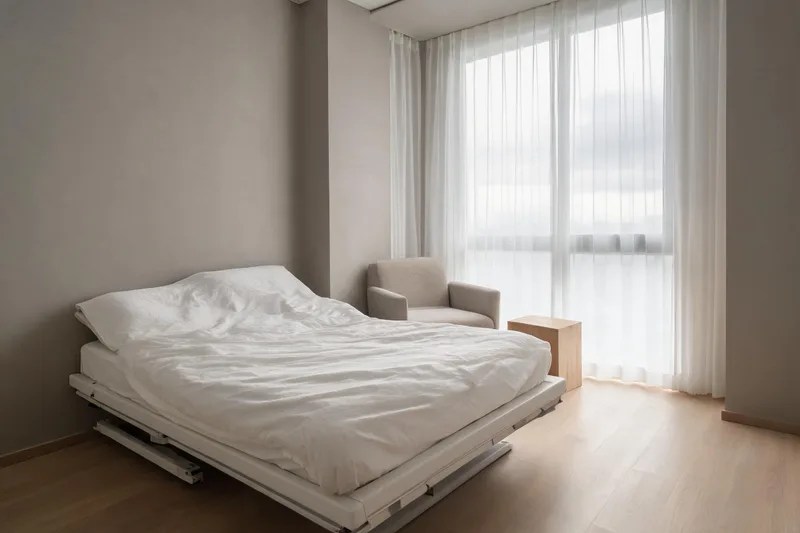
With a large height difference, a supported or raised bed edge lets the taller partner stand or kneel while the shorter partner sits, which erases the gap instead of straining to reach across it. A height-adjustable bed does the same job with more precision.
Where weight differences are large, prefer positions where the heavier partner’s weight rests on the bed and not on the other person, and avoid anything with a lifted partner; receiver-on-top is usually easier when the weight spreads through the thighs instead of concentrating on the knees.
For plus-size readers the binding constraint is usually hip flexion rather than strength. Abdominal and thigh circumference reduce how far the hips can fold before the position becomes uncomfortable, which makes deeply flexed positions a poor fit no matter how fit you are. Elevating the pelvis on a firm wedge changes the angle without demanding more range.
Positions that keep the hips close to neutral, like side-lying and rear-entry with the receiver on elbows, stay available when the deeper ones do not, and a small external vibrator restores stimulation without asking the hips to do anything they cannot.
Pregnancy, joint pain and recovery: what changes, and when to stop
Two questions come up here, and they have different answers. During an uncomplicated pregnancy, what changes is the position and not the activity: sex usually does not need to stop, but as the abdomen grows the mechanics shift, with pressure on the abdomen, prolonged lying flat on the back, and balance that moves forward with your centre of gravity. Side-lying and receiver-on-top avoid all three; flat on the back does not.
When to stop is the other question, and it depends on whether you have a specific restriction. If a clinician has told you to avoid a particular angle, or you are recovering from joint or pelvic surgery, treat that restriction as a hard filter on positions rather than something to test by feel.
That is the same logic as the joint limits above, just with a stricter threshold. Persistent pain during sex is common. In one British population survey, 7.5% of women reported painful sex lasting three months or more in the past year, and it is a reason to change approach and to seek advice, not to endure it (Mitchell et al., BJOG, 2017).
One more variable costs nothing to change: when. If a joint or a back is stiffest first thing in the morning, the position you can hold at 8am may be one you cannot hold at 11pm, and the reverse.
What actually makes any position easier
Two changes remove most of the mechanical friction from a position: a height-matched support surface, and enough lubricant. The first moves load from the body to the furniture. The second removes friction, which is the most easily fixed and most frequently ignored cause of discomfort. Neither has been tested head-to-head against the alternatives, so treat what follows as mechanical reasoning and clinical common sense rather than measured results. Both are cheap, reversible and immediately testable, though, which is more than most position advice can offer.
A firm wedge or a folded pillow under the hips changes the angle at the pelvis, which is the variable that governs how much hip range a position demands. A firm surface generally beats a very soft one, because a deep mattress absorbs the downward force you are trying to transmit, which makes every position harder to hold. Cushions and wedges are cheap, discreet to buy, and they work immediately, which is not something flexibility training can claim.
On lubricant, the base matters more than the brand. Water-based is the safe default because it works with every condom and every toy material, and it needs reapplying. Silicone-based stays slick far longer, which suits longer or water-adjacent scenarios, but it damages silicone toys. Oil-based belongs to massage and solo use only because it degrades latex. Our comparison of water-based, silicone and oil lubricants covers the safety detail, including the osmolality figure worth checking on any label.
Last, pace. Only 18% of women in a large US probability sample said vaginal penetration alone was sufficient for orgasm, while about 73% said clitoral stimulation was either necessary or made orgasms better (Herbenick et al., Journal of Sex & Marital Therapy, 2018). If a position leaves no hand free and no access for a toy, that is a limitation of the position itself.
Adding a small vibrator or a vibrating ring changes that arithmetic without requiring anybody to be fitter. If you are introducing one for the first time, our guide to bringing a toy into your routine without awkwardness covers the conversation, and toys built for two covers the categories that work alongside any position.
Frequently asked questions
Is sex a good workout?
It is a real moderate-intensity cardiovascular stimulus and a poor substitute for exercise. Couples averaged 5.8 METs and roughly 85 kcal over 24.7 minutes in laboratory measurement (Frappier et al., PLOS ONE, 2013). That is meaningful intensity and a small total dose. Train for the positions you want; do not count sex as the training.
What is the easiest position if you are not fit?
Side-lying and edge-of-bed or supported variants, because the bed carries the weight and nobody has to hold their own bodyweight. Test any position by whether you can hold it for three minutes without your muscles shaking. Receiver-on-top is a step up from tier one: it hands the receiving partner control of depth and pace, but they also have to hold their own torso upright while using it.
Are standing sex positions safe?
They can be, and they are the least forgiving category, so the setup matters more than the position itself. Standing asks for lower-limb endurance, balance and a way around the height difference between two people, and all three can be offloaded onto the room. A wall, a counter or a bed edge takes the balance demand out of it, and letting the shorter partner sit or lean removes the height problem entirely.
What are the best positions for back pain?
It depends on which partner is flexion-intolerant, because the same position loads the two people differently. In motion-capture testing, side-lying rear-entry and missionary with the hips and knees flexed produced the highest lumbar flexion load for the thrusting partner, while rear-entry with the receiver on hands and knees was the most spine-sparing (Sidorkewicz, University of Waterloo, 2013, ten couples).
For acute back pain with movement intolerance, the recommendation in that research is to avoid intercourse until it settles, and to see a clinician or pelvic health physiotherapist for chronic pain.
How do you manage a big height difference?
Take the height difference out of the equation instead of compensating for it. A bed edge, a chair, a counter or a height-adjustable bed lets one partner stand or kneel while the other sits, which removes the mismatch. Height-adjustable beds exist specifically because this is a common problem, not a niche one.
Are these positions safe during pregnancy?
During an uncomplicated pregnancy, sexual activity usually does not need to stop, but avoid prolonged lying flat on your back and any position that puts pressure on the abdomen; side-lying and receiver-on-top are the usual substitutions. If you have any pregnancy complication or a clinician has given you a restriction, follow that instead of any general guidance, including this one.
What to do first
Identify your binding constraint, then work in this order.
- Name the constraint. Spinal flexion, hip range, balance, or pace? The table grades all four for every position, so match your body type and fitness level against that one column.
- Pick the fitness tier you can hold for three minutes, not the tier you would like to be in. Dropping a tier costs nothing. Pushing through one can cost a week of back pain.
- Adjust the surface before the position. A wedge, a firmer mattress or a bed edge changes the angle at the hips more cheaply than flexibility work does.
- Then fix comfort. A well-matched lubricant, a free hand, a small toy.
If you would rather start with the practical items, the sexual wellness range covers lubricants and protection, which is where most of the immediate improvement comes from.