
Pick up any three bottles of lubricant and they’ll look more or less the same: a clear gel or liquid in a pump or squeeze tube. What separates them isn’t the packaging — it’s the base. Water, silicone or oil, and that single ingredient decides whether the bottle is safe with your condom, whether it will ruin your silicone toy, how it feels on sensitive skin, and whether it rinses off or stays slick in the shower. Most people learn this the hard way, after a tacky toy, a broken condom or a stinging rash.
This guide fixes that. It compares the three bases head to head, explains the one safety number the World Health Organization cares about and no label prints, and finishes with a quick chooser so you can match the base to the job in about thirty seconds. If you’re building a broader picture of intimate health, our sexual wellness guide for Middle East couples sets the context; this article is the practical, which-bottle-do-I-buy companion to it.
Key Takeaways
- Water-based is the safe default. It works with every condom and every toy material including silicone, doesn’t stain, and rinses off with plain water. The trade-off is that it dries out and needs reapplying.
- Silicone-based lasts the longest and stays slick in water — the pick for anal play and the shower — but it degrades silicone toys and needs soap to wash off.
- Oil-based is for massage and solo use only. It destroys latex condoms and stains fabric, so it’s a specialist, not an everyday choice.
- Check osmolality, not just the base. The WHO recommends lubricants stay near your cells’ own balance — ideally under 380 mOsm/kg, with 1,200 as the outer limit — yet many common products test at 2,000–6,000 mOsm/kg, which can irritate delicate tissue.
- In the UAE, water-based is the discreet all-rounder — small, condom-safe, washes off traceless, and available with discreet packaging and cash on delivery.
The three bases at a glance
Before the detail, here’s the whole decision in one table. Find your situation down the side and the right base reads straight across.
| Water-based | Silicone-based | Oil-based | |
|---|---|---|---|
| Latex condoms | Safe | Safe | Breaks them |
| Silicone / TPE toys | Safe | Degrades them | Varies — avoid on TPE |
| Stays slick in water | Washes away | Yes | Yes |
| Longevity | Reapply often | Longest-lasting | Long-lasting |
| Cleanup | Rinses with water | Needs soap | Needs soap, stains |
| Sensitive skin | Gentlest option | Usually fine | Can clog / irritate |
The pattern in that table isn’t an accident. Water-based is the only base that never creates a problem — it’s safe in every single row. Silicone and oil each win on one specific job (longevity and glide respectively) and lose badly on others. That’s why the rest of this guide treats water-based as the default and the other two as specialists you reach for deliberately.
What the table doesn’t show is the safety dimension that has nothing to do with the base: osmolality. We’ll come to it after the three bases, because it applies to all of them.
Water-based lubricant: the everyday default
If you only ever buy one bottle, make it water-based. A water-based lubricant is a gel or liquid whose main ingredient is water, built to sit light on the skin and rinse away rather than leave a greasy film. That simple base is exactly why it’s the most forgiving option: it’s safe with latex and polyisoprene condoms, compatible with silicone and TPE toys, and non-staining. “Water-soluble” describes the same property from the other end — at the end of a session it lifts off with a quick rinse or a damp cloth. Whatever you plan to do, a water-based lube rarely causes a problem.
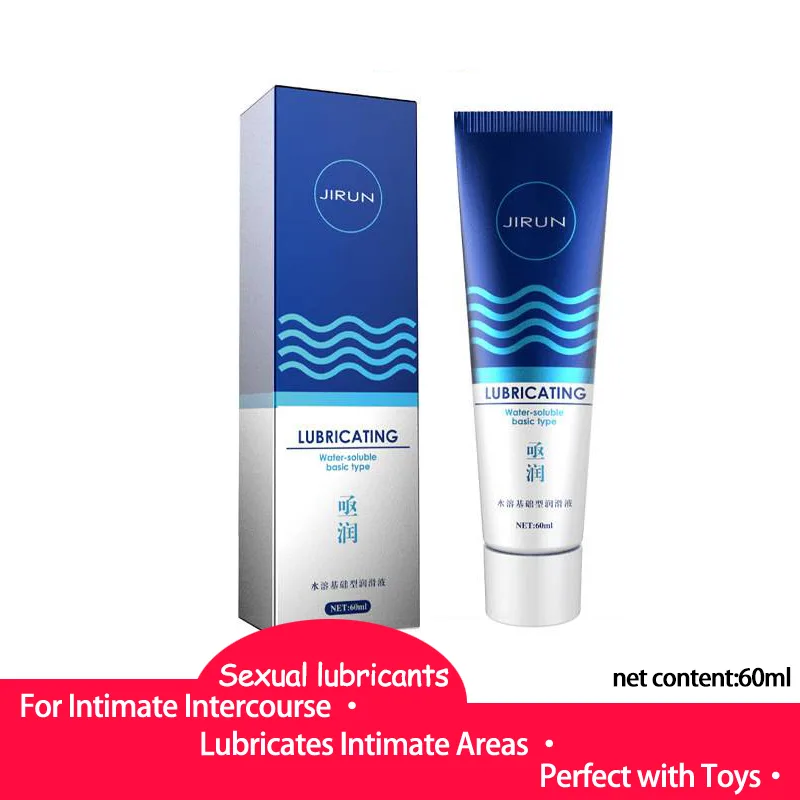
Water-based formulas aren’t all identical, and the differences matter more than the label. A plain gel does the basics well: it glides, it rinses, it stays out of the way. A humectant formula adds a moisture-retaining ingredient such as sodium hyaluronate, which helps the surface stay slick longer instead of drying into tack. A lickable build is formulated to be safe and pleasant for oral play — water-based and non-sticky so it wipes away easily. And warming or sensation variants add a gentle heat for a different feel. The base is the same water in all of them; the formulation is what you’re actually choosing between, and it changes how often you reapply, how it feels on sensitive skin, and whether it suits oral use.
The honest downside is longevity. Water absorbs into the skin and evaporates, so a water-based lube dries out faster than the other two and wants topping up. For most people that’s a fair trade for the compatibility and easy cleanup — and reapplying takes two seconds. For sensitive skin this is also the gentlest base, especially the colourless, odourless formulas that leave out fragrance and dye.
Silicone-based lubricant: long-lasting and waterproof
Silicone-based lube is the endurance specialist. Because it isn’t water-soluble, it doesn’t absorb into the skin or evaporate — it sits on the surface and stays slick far longer than water-based, so you apply once and rarely top up. It’s also waterproof, which makes it the only base that keeps working in the shower, bath or pool. For long sessions and for anal play, where there’s no natural lubrication and friction is highest, that staying power is exactly the point.
There’s one hard rule, and it’s the most important sentence in this section: never use silicone-based lubricant on a silicone toy. Silicone lube chemically degrades silicone surfaces — over a few uses the toy turns tacky, then rough, then porous, and a porous toy can’t be properly cleaned. The same caution extends to TPE. So the compatibility flips completely: silicone lube is the best choice for your body and the worst choice for your silicone toys. Check what the toy is made of before you reach for the bottle.
The trade-offs are cleanup and cost. Silicone doesn’t rinse off with water — you need soap — and it can leave light marks on sheets if you’re generous with it. It also tends to cost more per bottle than water-based. Most people end up owning both: water-based as the everyday default and toy-safe option, silicone kept aside for shower play and anal. If anal is the reason you’re here, our guide to why anal play needs special lubrication goes deeper on technique, quantity and the numbing-cream risk.
Oil-based lubricant: massage and solo only
Oil-based lubricant is the specialist with the shortest safe-use list. It gives a long-lasting, cushiony glide that many people like for massage and for solo use, and it doesn’t dry out. But it comes with two serious deal-breakers that rule it out for most partnered sex.
The first is condoms. Oil destroys latex. It breaks down the latex structure within minutes and can cause a condom to fail — which makes oil-based lube incompatible with the most common form of protection. If condoms are anywhere in the picture, oil is off the table. The second is mess: oil stains fabric and needs soap and real effort to wash off skin and sheets. It can also clog pores and irritate sensitive tissue, so it’s a poor choice internally for many people.
That leaves oil-based in a narrow but legitimate niche: external massage, and solo play where no condom and no silicone toy is involved. If that’s what you want it for, it does the job well. For anything involving a partner and a condom, pick one of the other two bases.
What the WHO says about lubricant safety
Here’s the part almost no label tells you, and it applies to every base above. The safety of a lubricant isn’t only about water versus silicone versus oil — it’s about how the formula interacts with your tissue at a chemical level. The measure that matters most is osmolality: how concentrated the lube is compared to your own cells.
Healthy vaginal fluid sits at roughly 260–370 mOsm/kg. In its advisory note on personal lubricants, the World Health Organization recommends that a lubricant stay close to that balance — ideally at or below 380 mOsm/kg, with 1,200 mOsm/kg treated as the outer acceptable limit in practice. The problem is that most commercial lubricants are nowhere near it. Testing of widely sold products has found osmolality from around 2,000 up to 6,000 mOsm/kg — four to thirty times the concentration of vaginal fluid (WHO/UNFPA advisory note on lubricant osmolality).
Why does a high number matter? A strongly hyperosmolal lubricant creates an osmotic gradient that pulls water out of the epithelial cells lining the vagina or rectum. Those cells dehydrate and shrink, the protective barrier weakens, and the tissue becomes more vulnerable to irritation and infection. A 2018 study using a three-dimensional vaginal epithelium model found that lubricants above about 1,500 mOsm/kg markedly reduced the barrier’s integrity and damaged the underlying cell layers, while iso-osmolal formulas caused no such damage (Ayehunie et al., 2018). In plain terms: a lube can feel slippery and still be quietly stressing the tissue it’s meant to protect.
Two companion rules come from the same WHO guidance. Keep glycerol (glycerin) at or under 9.9% and propylene glycol low, since both push osmolality up and can feed irritation or yeast in susceptible people; and prefer a pH around 4.5 for vaginal use to match the body’s natural acidity. The practical takeaway: among water-based options, favour the simple, low-additive, fragrance-free formulas marketed for sensitive skin — they’re the most likely to sit near the body-friendly end of these ranges. This is the checklist we apply to the lubricants we stock.
How to choose by use case
Put the bases and the safety rules together and the decision gets simple. Find your situation:
- With a condom (any kind) → water-based or silicone-based. Never oil.
- With a silicone or TPE toy → water-based only. Silicone lube will degrade the surface.
- Anal play → silicone-based for longevity, or a thick water-based gel reapplied generously. Never a numbing formula.
- Sensitive skin or prone to irritation/yeast → a fragrance-free, low-additive water-based lube with low osmolality and pH ~4.5.
- Shower, bath or pool → silicone-based, the only base that stays slick in water.
- Massage or solo, no condom → oil-based works, if you don’t mind the cleanup.
- Just want one bottle that covers everything → water-based. It’s the default for a reason.
Notice that water-based appears in almost every line. That’s the whole thesis of this guide: it’s the one base you can buy once and use everywhere, which is why it dominates our lubricant range and why the water-based collection is where most readers should start.
How to use lubricant properly (and how much)
The most common lubricant mistake isn’t choosing the wrong base — it’s using too little. Friction is the enemy, and a thin, stingy layer wears through fast. Here’s the method that works regardless of base:
- Start with a coin-sized amount. Squeeze or pump a blob onto your fingers, not straight onto cold skin — warming it between your hands for a few seconds takes the chill off.
- Apply to both parties or to both you and the toy. Coating only one side means the dry side strips the layer off within a few strokes.
- Reapply at the first sign of drag. The moment glide turns to drag, add more — don’t push through friction. This is the single habit that prevents soreness and micro-tears. Keep the bottle within arm’s reach so topping up doesn’t break the mood.
- Add water to revive water-based. If a water-based lube starts to feel tacky, a few drops of water (or a wet hand) reactivates it before you reach for a full reapplication.
- Clean up according to the base. Water-based rinses off with plain water; silicone and oil need soap. Wash toys per their material — and never let a silicone toy near silicone lube residue.
There’s no such thing as too much lube, only too little. Generosity here is what makes the difference between uncomfortable and effortless.
Buying lubricant in the UAE
For readers in the UAE, water-based is the discreet all-rounder on top of everything else. It’s compact, it’s the safest base for condoms and toys, and it washes off without a trace. The practical side of ordering is simpler than most people expect: reputable stores ship in plain, unmarked packaging, and cash on delivery means no product name appears on a card statement. Our guide to discreet delivery and payment in the UAE walks through exactly how the packaging and COD process work if privacy is your main concern.
We keep the lubricant range focused on the body-friendly end of the spectrum — water-based formulas with simple ingredient lists, including humectant, lickable and warming variants — because those are the ones that sit closest to the WHO guidance above. Browse the full lubricant collection or go straight to the water-based range if you want the safe default. Everything ships discreetly across the UAE with cash on delivery.
Frequently asked questions
Is water-based or silicone lubricant better?
Neither is universally better — it depends on the job. Water-based is the safe default: compatible with every condom and every toy material, easy to clean, and gentlest on sensitive skin, but it dries out and needs reapplying. Silicone-based lasts much longer and stays slick in water, making it better for anal play and the shower, but it degrades silicone toys and needs soap to remove. Most people keep water-based as the everyday bottle and silicone for specific situations.
Can I use silicone lube with silicone toys?
No. Silicone-based lubricant chemically degrades silicone toy surfaces — over a few uses the toy becomes tacky, then rough, then porous, and a porous surface can’t be cleaned properly. The same caution applies to TPE. For any silicone or TPE toy, use water-based lubricant only.
What lubricant is safe for sensitive skin?
Choose a fragrance-free, dye-free water-based formula with a short ingredient list. Beyond the base, look for low osmolality and a pH near 4.5: the WHO recommends lubricants stay ideally under 380 mOsm/kg (1,200 as the outer limit), because highly concentrated formulas can pull moisture out of delicate tissue and cause irritation. Simple, low-additive water-based lubes marketed for sensitive skin are the most likely to meet that bar.
Does lubricant expire, and how should I store it?
Yes — check the date on the bottle. Store lubricant somewhere cool and dry, out of direct sunlight. Water-based formulas can dry out or separate once opened, so replace the bottle if the texture, smell or colour changes. Don’t share pump bottles between anal and vaginal use without cleaning, to avoid transferring bacteria.
Conclusion
The whole decision comes down to matching the base to the job:
- Water-based is the default — condom-safe, toy-safe, non-staining, gentlest on sensitive skin; just reapply it.
- Silicone-based is the endurance pick for anal and water play — but never on silicone toys.
- Oil-based is for massage and solo use only — it breaks latex condoms.
- Whatever the base, favour low-osmolality, low-additive formulas — the WHO guidance (ideally ≤380 mOsm/kg, pH ~4.5) is the safety check no label prints.
Get the base right and everything else — comfort, safety, toy longevity — falls into place. Ready to pick a bottle? Start with the water-based lubricant range for the all-round safe choice, delivered discreetly anywhere in the UAE with cash on delivery.